
TrapNexus
A complete drug economy for FiveM. Not another selling script.
Players harvest ingredients across the map, craft them into product worth selling, and move it on the street, out of a vehicle, or on timed bulk contracts. Reputation, ranks and heat carry between sessions, so a dealer builds an operation instead of repeating a transaction. Server owners get the whole economy in one admin panel: prices, recipes, zones, ranks and payouts, all editable in game and live without a restart. Every value that decides money or items is settled server-side.
$49.99 once — licensed for up to three servers you own and operate.
What it gives your server
One economy instead of four disconnected scripts
Growing, cooking and selling usually come from different resources that share no prices, no progression and no admin panel, so balancing one breaks another. TrapNexus runs all of it off the same numbers: what a dealer is paid on a corner follows from the same configuration that set the harvest yield and the cook time.
Tune it against your server
Payouts, yields and durations are starting points, not defaults you are stuck with. They are edited in game and take effect without a restart, so balancing stays an ongoing adjustment and never becomes a deployment.
Cheating is a server decision
Because the values that matter are computed server-side and every request is validated, exploiting the loop means defeating the server. Editing a client file achieves nothing.
You can see what happened
Every economy action and every administrative change is recorded with its reason, so a report of “the money disappeared” is answerable from data instead of guesswork.
Verified functionality
What ships in this release
Everything in this list exists in the current release. Anything planned is kept separately, further down, and clearly marked as not part of what you are buying.
Ingredient harvesting
Gathering zones placed anywhere on the map, one per ingredient, each with its own radius, duration and yield range. Players stay free to move while working, and yields are rolled server-side.
Multi-input crafting with quality
Recipes take any combination of inputs and produce any combination of outputs, with a quality roll that carries through to what the product sells for. A failed inventory or payment step rolls back the whole craft.
Three ways to move product
Summon a buyer to a street corner, deal from the driver's seat, or run a timed bulk contract to a drop point for volume at a thinner margin. Each has its own payout curve, heat and risk.
Ranks, reputation and heat
A persistent XP curve across six ranks with rising payout multipliers, sale streaks, a server-wide leaderboard, and heat that suppresses prices until a player goes quiet long enough for it to decay.
Live economy control, no restart
Products, recipes, harvest zones, suppliers, market zones, economy values and ranks are all edited in the in-game admin panel, written to the database and pushed to connected players immediately.
Full audit trail
Every economy action and every admin change is recorded with the reason and context behind it, including the ones the server refused. “The money disappeared” is answerable from data.
Server-authoritative transactions
Prices, random outcomes, inventory changes, payments, quality, ranks and heat are all decided on the server. The client is treated as untrusted input throughout.
Built to resist client-side exploits
Crafting and harvesting hand out a server-side token and check the completion against it, so a client cannot shorten its own progress bar, finish from outside the zone, or replay a completed action. Token lifetimes and the exact checks are documented.
Rate-limited, allowlisted requests
Remote calls are allowlisted, rate-limited, serialised per player and permission-checked, with proximity and state validation on the actions that need it.
Compatibility
Tested, supported, and not integrated
If it says tested here, it was actually tested: the whole loop run end to end against that combination. Supported means it shares a tested code path but that exact pairing has not been run yet. Not integrated means no adapter ships and you would be writing it. Three different things, never merged into one green tick.
| Component | Status | Detail |
|---|---|---|
| QBCore | Tested end to end | Detected automatically; a standard install needs no configuration for detection. |
| ESX Legacy | Tested end to end | Detected automatically; a standard install needs no configuration for detection. |
| Component | Status | Detail |
|---|---|---|
| qb-inventory | Tested end to end | With QBCore. Stores per-item quality metadata, so the quality price curve is active. |
| esx_inventory (native) | Tested end to end | With ESX Legacy. Has no per-item metadata, so crafted quality falls back to a flat value and the quality price curve is inactive. The limitation belongs to the inventory, not to TrapNexus. |
| ox_inventory with ESX Legacy | Tested end to end | Quality metadata verified by round trip: a craft rolled a value, and the sale that followed read the same value back out of the inventory. |
| ox_inventory with QBCore | Tested end to end | Stores per-item quality metadata, so the quality price curve is active. The full loop has been run against this combination. |
| Component | Status | Detail |
|---|---|---|
| Framework-native notifications | Tested end to end | Uses whichever notification system your framework already provides. |
| Component | Status | Detail |
|---|---|---|
| ox_target, qb-target and similar | Not integrated | Interaction is a keypress prompt. No target adapter ships. |
| Component | Status | Detail |
|---|---|---|
| ps-dispatch, cd-dispatch and MDT integrations | Not integrated | The police alert is a documented configuration hook with a working default that notifies on-duty police. Wiring a dispatch resource to it is a change you make yourself. |
Requirements
What your server needs
Dependencies
- oxmysql
- OneSync, because sale validation uses server-side entity natives
- QBCore or ESX Legacy
- MySQL or MariaDB, accessed through oxmysql
Source accessibility
Distributed through Cfx.re Keymaster escrow. The client and server Lua are encrypted. Configuration, shared utilities, the database schema, the item definition packs and the documentation are left readable and editable, because the product cannot be configured or installed otherwise.
Installation
What installation involves
An outline, not a substitute for the documentation. Each step is written up in full with the exact commands and values.
- 01Ensure oxmysql is running and your framework has started.
- 02Import the database schema, or let the resource create its tables on first start.
- 03Add the item definitions using the pack that matches your inventory. The three packs are on different weight scales and must not be mixed.
- 04Add the resource to your server configuration and start it.
- 05Confirm the console reports the framework and inventory it detected, then run the loop once on a development server before opening it to players.
Demonstration and measurements
See it in game
Demonstration video
A recorded walkthrough of the loop, opened in a new tab rather than embedded, so no third-party player loads on this page.
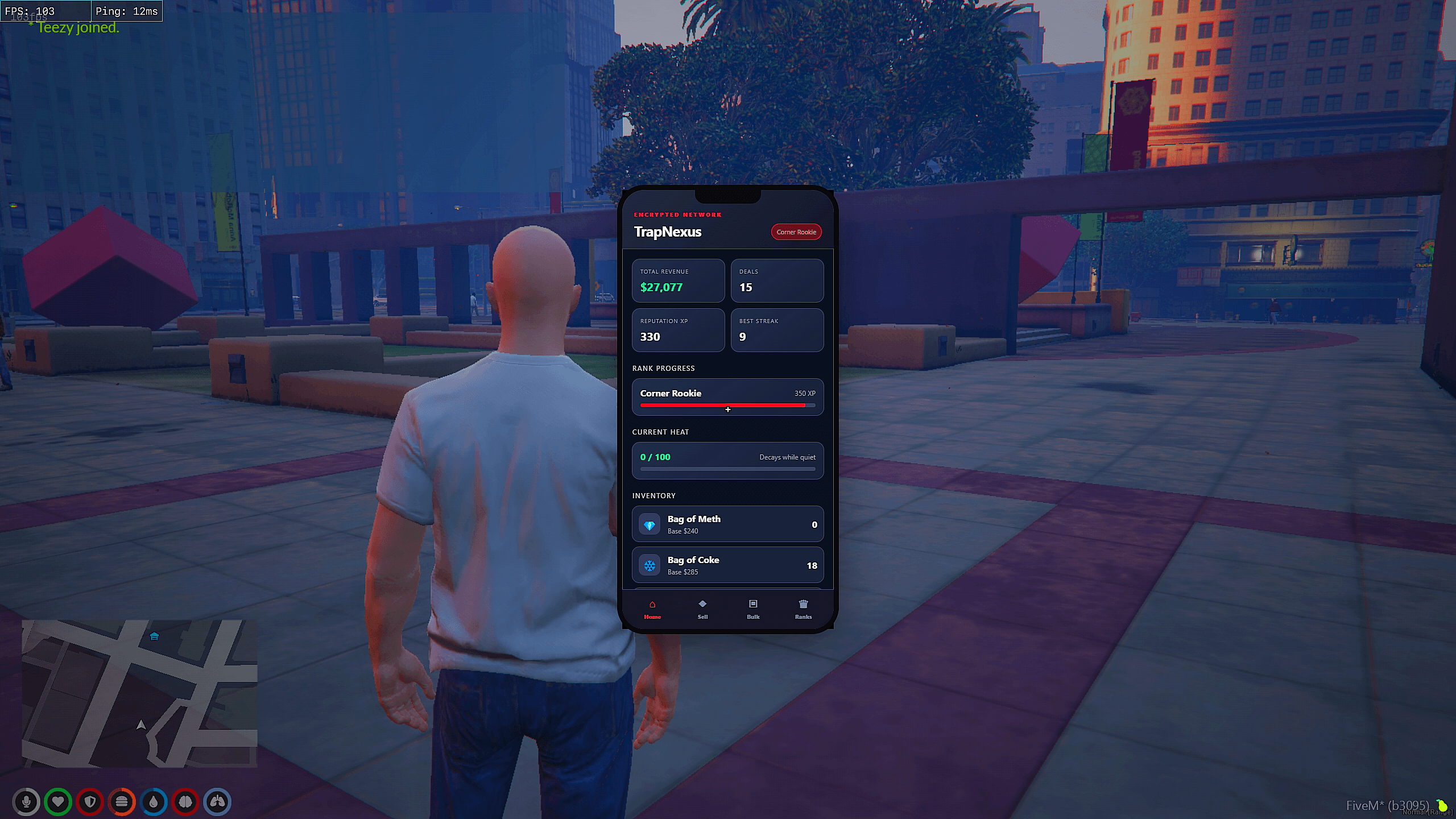
The trap phone. Revenue, rank, heat and stock in one place, and the only interface a player needs. 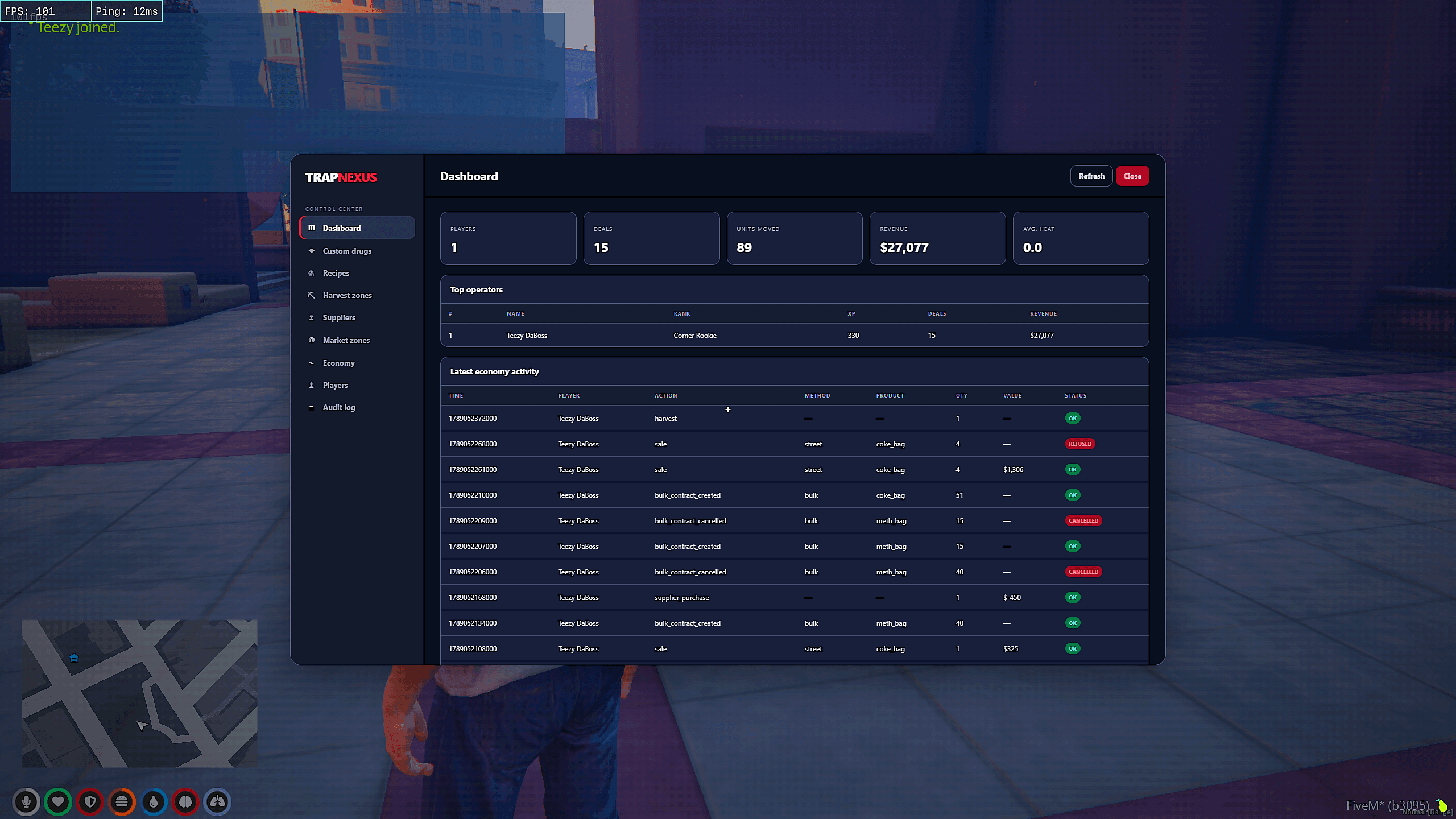
The admin console. Every economy action is recorded, including the ones the server refused. 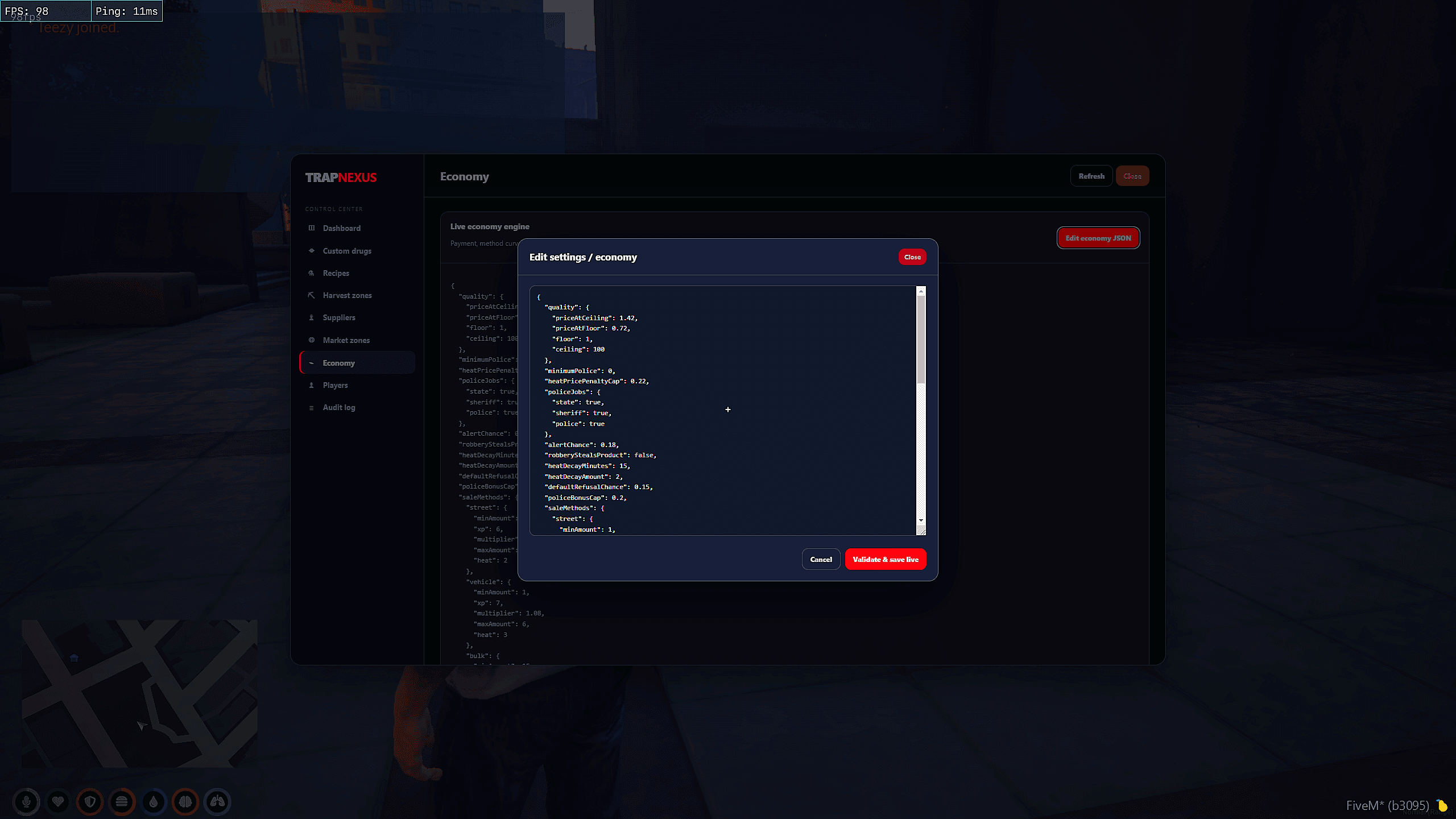
Economy settings are edited in game and validated before they persist. No config file, no restart. 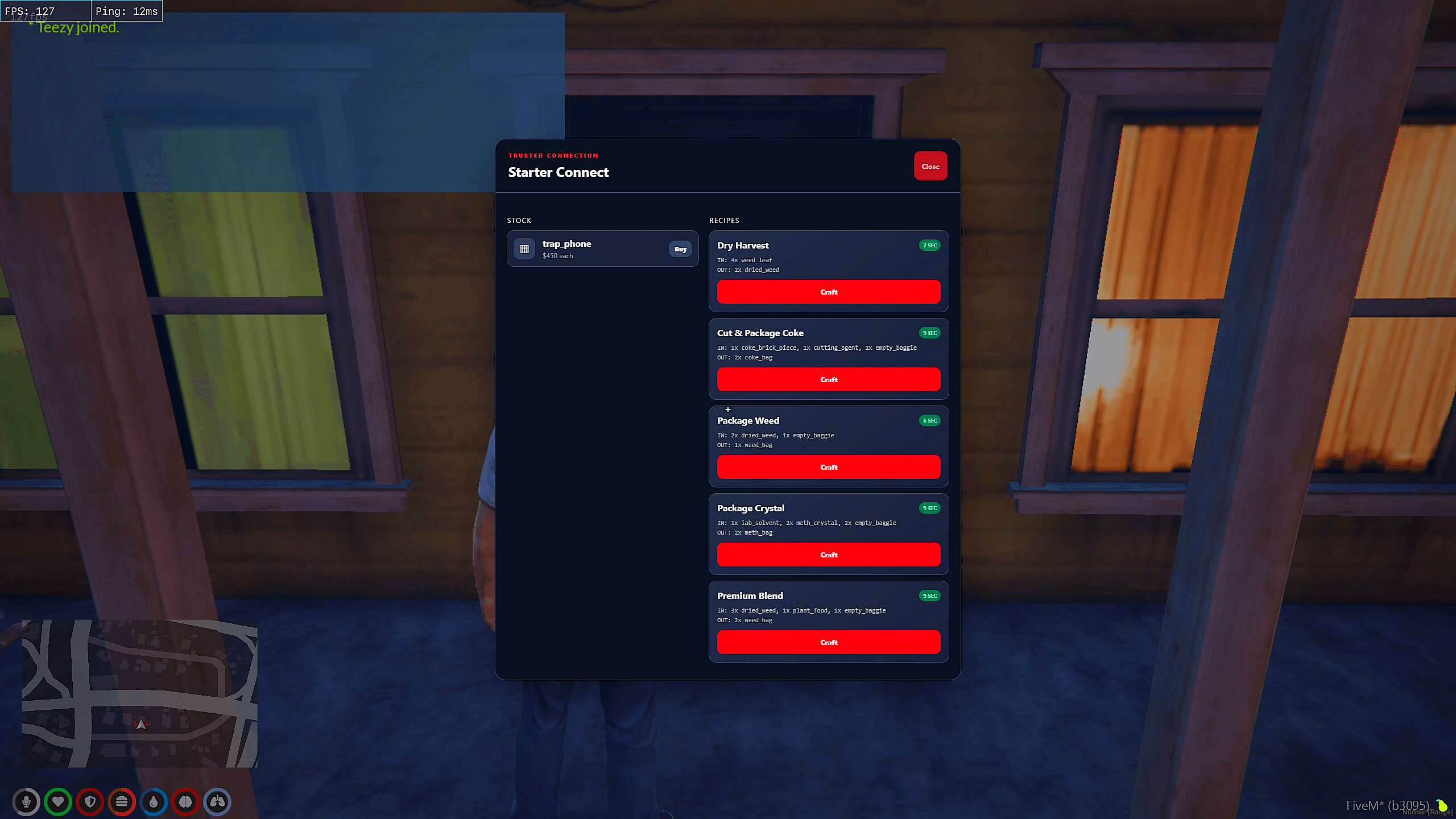
Suppliers sell stock and expose recipes. Inputs, outputs and timings are all editable.
Performance evidence
No performance measurements have been published. Rather than quote a resource-monitor figure taken on an empty server, this section stays empty until there is a measurement worth standing behind, taken in a stated environment on a stated date.
Before you buy
Known limitations
Published here, before you buy. If any of these rule it out for your server, that is the right outcome.
The native ESX inventory cannot store per-item quality
On esx_inventory, crafted quality falls back to a flat value and the price curve based on it is inactive. This is a limitation of the inventory, not something a future TrapNexus update changes. qb-inventory and ox_inventory both store metadata and run the full curve — pairing ESX Legacy with ox_inventory instead is tested end to end and resolves this.
Roadmap — not included
Intentions for later versions
These are intentions, not commitments. They are not part of what you are buying, and no purchase should be made in reliance on them.
- Territory and gang economics, pooled earnings, contested demand
- Interactive negotiation, customer memory and repeat clientele
- Hireable NPC dealers with consignment stock
- Planting and growing, placeable processing, lab ownership
- Drug effects, consumables and evidence items
- Dispatch adapters and target integration
- Per-batch provenance, anomaly detection and administrative rollback history
- Localisation
Releases
Recent changes
0.3.0-alpha
Makes the cost of a failed street deal a server decision, and tightens buyer verification now that it can be relied on.
0.2.0-alpha
Replaces buying ingredients with gathering them, and replaces hunting for a pedestrian with summoning a buyer.
Support and licensing
What is covered
Support scope
Installation, configuration, and defects in the resource as delivered. Custom development, integration with third-party resources, and problems caused by your own modifications fall outside that scope.
Licence
One purchase licenses up to three servers you personally own and operate, so a development or staging server does not require a second purchase. Redistribution, resale and circumventing escrow are prohibited.
Questions
Frequently asked
- Do I need to configure the framework or inventory?
- No. Both are detected at start, and the console prints what was found. A standard QBCore or ESX Legacy install needs no configuration for detection to work.
- Why is item quality flat on my server?
- Per-item quality needs an inventory that stores metadata. qb-inventory and ox_inventory do. The native esx_inventory does not, so quality falls back to a flat value and the price curve based on it is inactive. If quality tracking matters for your server and you are on ESX Legacy, pairing it with ox_inventory instead resolves this — that combination is tested end to end and runs the full curve.
- How many servers does one purchase cover?
- Up to three that you personally own and operate, so a development or staging server does not need a second purchase.
- Can I edit the configuration?
- Yes. Configuration, the database schema, the item packs and the documentation are left readable and editable. The client and server Lua are encrypted through Keymaster escrow.
- Do I need Discord to use TrapNexus?
- No. Discord is where support and community happen, but the resource neither requires nor contacts it. Nothing about installing or running it depends on Discord.
- What does the alpha label actually mean?
- The loop is complete and has been tested end to end on live servers, but it is early software: expect bugs, and treat everything on the roadmap as an intention. Three releases in, configuration and data changes have all shipped through automatic migrations without breaking anyone's setup. Concurrent load has also been tested: a scripted 50-concurrent-seller load surfaced real issues on its first run, and after fixes it has since completed four consecutive clean runs at that load with no errors. The remaining alpha limitations on this page still apply.
Purchase
$49.99, once
Checkout is handled by the store, not by this site. Riftvane does not collect or process payment details here.
Riftvane Studios is an independent creator and is not approved, sponsored, or endorsed by Rockstar Games, Take-Two Interactive, or Cfx.re. FiveM is a trademark of Take-Two Interactive Software, Inc.